Overview
After wrapping up some fixes for the game I’m developing, I found myself idly pondering why Edge Poker adopted those particular game rules. The fundamental reason likely stems from the developer’s revenue structure being that of a social game. While this topic differs in tone from recent posts, I’d like to share my speculation on why this might be the case.
Social Game Revenue Structure
When playing social games, how much do players typically spend per game? Generally, annual spending seems to fall into the following categories.
- Extreme spenders (Whales): ¥3-10 million annually (0.5-1%)
- Heavy spenders: ¥500,000-1 million annually (4-5%)
- Light spenders: ¥100,000-200,000 annually (20-30%)
- Non-spenders: ¥0-50,000 annually (60-70%)
Considering the play experience of social games with monthly passes (around ¥2,000-3,000) and gacha mechanics, the image might be something like this.
- Whales: Max out and fully complete nearly every event.
- Heavy spenders: Spin the gacha for nearly every event. Max out powerful characters.
- Light spenders: Monthly pass + (1-2 times a year) spin the gacha to get favorite characters.
- Non-spenders: Pay nothing or only the monthly pass.
Incidentally, I personally play one or two games where I spend a little, but mostly fall into the non-spending category. To simplify the discussion, the amounts and composition ratios are simplified as follows.
- Whales: 5 million yen (1%)
- Heavy spenders: 500,000 yen (5%)
- Light spenders: 100,000 yen (25%)
- Non-spenders: 0 yen (69%)
Analyzing social game revenue based on this reveals that the top 1% of players generate 50% of revenue, and the top 6% account for 75%. When playing as a non-spender or light spender, seeing a game with only about 10,000 players generate annual revenue of 1 billion yen makes you wonder how they achieve that. The reality is that this revenue is largely supported by a very small number of heavy spenders and whales.
Of course, social game developers don’t provide the same game experience to all these tiers. They likely adjust game balance to ensure each tier receives an experience commensurate with their spending. Viewed this way, the users social game developers must prioritize listening to are the heavy spenders and whales. As for the light spenders and free players, even if they whine and complain, the developers can just think, “We’re reflecting on it~ (ugh, so noisy)” and move on. When controversies erupt over game balance adjustments or event items, it’s almost always because measures favoring heavy spenders have caused low spenders and non-spenders to lose their temper.
P2W Elements Are Necessary
To provide different game experiences based on spending levels, introducing P2W (Pay to Win) elements into the game is necessary. While almost no social game explicitly states “This game is P2W,” it’s implemented in ways designed to be as obscure as possible (though it’s obvious if you think about it). Sometimes characters obtained via gacha are simply stronger. Other times, stamina (life points) is required to progress through the game or earn points in events. Spending money allows players to gain an advantage over others.
A typical example is a game where players compete to see who can earn the most points during an event, with the top players’ rankings displayed on the game’s homepage. To secure a high position in this competition, players need to obtain characters (special effect characters) that drop from the event gacha and spend stamina to repeatedly run the event. As a result, the players featured on the game’s homepage are almost always a list of heavy spenders or those who spend a lot.
Low-spenders and non-spenders are fundamentally unable to participate in this competition, while heavy spenders are blocked from reaching the top by the wall of extreme spenders. This creates fundamentally different gaming experiences. The Pay-to-Win (P2W) model is generally disliked by users (especially low-spenders and non-spenders), and even for extreme and heavy spenders, they likely don’t want to be perceived as simply throwing money around to satisfy their need for recognition. The skill of social game designers might lie in how subtly they can sneak P2W elements in while maintaining the facade of “We are not P2W.”
Social Game Monetization and Game Fairness Cannot Coexist
In gambling like poker or financial trading, there must be a guarantee (even if only for appearances) that the games are conducted fairly. This is likely because gambling venues rife with cheating, fraud, and discrimination struggle to attract large numbers of participants. It’s standard practice to stipulate in terms of service and by law that participants are treated equally and fairly, ensuring no specific player gains an unfair advantage.
In contrast, P2W elements are essential for monetization in social games. In game formats where players compete for rankings, the game design must inherently favor players who spend more money. This discrepancy between social game design and poker’s inherent requirement for fairness and equality might be the root issue with poker apps.
While pure poker players might expect top-ranked players to be skilled poker players, the reality is that the design makes it easier for players who spend more to rank higher, which likely fueled the controversy. This problem may be unavoidable, completely unrelated to who oversees the game, the nature of the game development company, or the planning abilities of the game producer/director.
One might think the solution is to switch the monetization method to solely monthly subscriptions, but achieving this requires securing a substantial number of players and retaining them. To generate ¥1 billion in annual revenue solely from subscriptions, you’d need to secure 50,000 to 100,000 players. However, a paid game from the start creates a high barrier to entry. Players who get bored or keep losing will cancel immediately, making this an unrealistic strategy.
Finally: Poker’s Revenue Structure in Casinos
Last year people won more than one billion dollars playing poker. And casinos made twenty-seven billion just by being around those people.
Samantha Bee
You might be wondering why I’m rambling on about such trivial things, but honestly, I felt this structure bears similarities to the revenue structure of poker in casinos. I saw a YouTube video where a pro poker player explained that casino revenue from poker is negligible. I thought, “No way, if you’re getting paid by the casino, you should label this video as containing promotional content.” But I started wondering if there might be a reason people are inclined to believe that.
Professional players who earn their daily bread through poker actually play mostly at low-stakes or, at most, mid-stakes tables, right? High-stakes games involve millions of yen per hand and don’t seem like the kind of game people needing daily income would play. In short, if you only look at the rake from low-stakes games, the claim that “the casino’s income is negligible” might not be entirely wrong. In reality, a similar structure exists to social games, and considering this correspondence, it becomes easier to understand. The bulk of a casino’s income likely comes from high-stakes tables, and low-stakes tables might exist partly to give high-stakes players a sense of superiority (comparing income to operating costs, low-stakes tables might barely turn a profit).
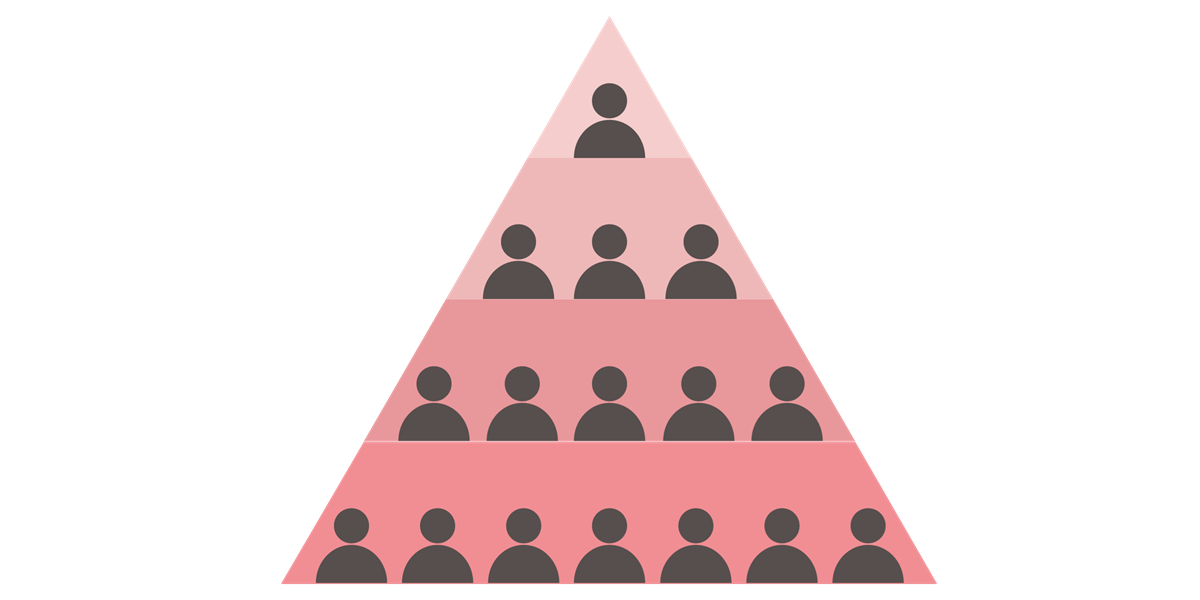
- High stakes… Extreme spenders
- Mid stakes… Heavy spenders
- Low stakes… Light spenders
While one might assume rake decreases as stakes increase, considering the rate of increase in bet amounts, it’s easy to see that the burden of fees is overwhelmingly heavier at high stakes. For example, suppose high stakes have a 2.5% rake and low stakes have a 5% rake. However, because the stakes are nearly 100 times different, a high stakes table bears nearly 50 times the rake per game compared to a low stakes table (this becomes the casino’s revenue). This means the revenue from one high-stakes table equals that of 50 low-stakes tables, making it clear which tier the casino relies on for its income.
Furthermore, since poker is essentially a zero-sum game excluding rake, tables with higher rake fees naturally have more players losing money. In other words, assuming players have the same skill level, the higher the stakes, the easier it is to lose money. You might often think that higher stakes mean stronger players, making it harder to win (and that might actually be true), but the real story is that higher stakes also mean higher rake, making it harder to win. It’s reasonable to assume that most players at high-stakes tables are losing money at poker. The reality is that these players are likely wealthy individuals who enjoy wasting their money on gambling.


Comments