
Overview
I am currently developing a poker game on my own, and I’d like to discuss the often-asked question of whether probability manipulation is possible in poker apps. To state the conclusion upfront: yes, it is certainly possible, and it’s not particularly difficult (though doing it without getting caught might be). Ultimately, it boils down to whether the app provider has the motivation to manipulate probabilities.
For online poker (illegal in Japan, though), there might be motivation to increase the probability of dealing cards that make players want to bet big. In social games, there might be temptations like favoring heavy spenders or rescuing players who lose frequently to prevent them from quitting. They’d likely want to avoid situations where heavy spenders get fed up and quit after losing too much. Even if these operators aren’t actually doing it, the constant suspicion of probability manipulation stems from the fact that you can’t definitively say the motivation doesn’t exist (in fact, it’s more natural to assume it does).
From the player’s perspective, if the app they are playing to practice or become stronger is rigged, they will be playing under false rules, which may not only prevent them from achieving their original goal, but may even be counterproductive. Therefore, players will want to avoid playing apps that are rigged as much as possible (although some players who spend a lot of money may think they should be treated well).
I think I’ll end this year’s posts with this one, but to tell you the truth, this is the 100th post on this blog. It may be my personal nature to discuss cheating in this commemorative post. (In Japanese, this article was written at the end of the year, so it means that it is the last post of 2025.)
Manipulating the Probability of Cards Dealt
In Texas Hold’em, there is a high probability that many hands will be folded immediately upon being seen. In 100bb games, it is said that a VPIP (Voluntary Pre-flop Involvement Percentage) of around 20% is optimal, so there is an 80% chance of folding immediately. If you’re unlucky, you might only be able to fold for 30 minutes to an hour (10 to 30 games).
If you’re used to it, that’s fine, but if you want to play games in a relatively short time, like online games, you might get bored with all the waiting. To avoid this, you can manipulate the probability of being dealt a hand combination that you would immediately fold. In poker, even if the probability of being dealt a hand that requires an immediate fold is lowered, it does not affect the fairness of the game, so it may be a probability manipulation that is difficult to notice.
There are several possible algorithms, but the simplest method would be to include an operation that returns the cards once or twice and redraws them when a weak hand is dealt (if it is still weak, it is distributed as is). As a result, it is possible to increase the probability of being dealt a hand that can be entered with the optimal strategy. Another method is to skew the probability of the cards dealt. Since most starting hands are in the range of A to T, setting the probability of drawing A to T higher only pre-flop can increase the probability of being dealt a starting hand.
A phenomenon that definitely occurs in poker apps where this manipulation is performed is that VPIP tends to be significantly higher than normal. This is probably why apps with excessively high VPIP are suspected of probability manipulation. Playing according to standard strategy naturally leads to a higher VPIP, and the win rate ends up being lower than expected (opponents are more likely to hold strong hands). In apps where this manipulation occurs, the optimal strategy becomes tighter than standard play, making it advisable to adjust your strategy to only enter with stronger hands.
Manipulating Player Win Rates
Another characteristic of Texas Hold’em is that surprisingly few games actually reach the showdown. In other words, opportunities to actually see what hands were dealt are relatively scarce. In high-level games, most hands are decided pre-flop or on the flop, with showdowns occurring in less than 5% of all hands. While m Hold’em and PokerChase seem to have a higher-than-average probability of reaching showdown, it’s still estimated to be only around 10-15% of all hands.
Due to this nature, even if hands are distributed to vary the probability of winning at showdown between players, it tends to be difficult to detect. If the game is implemented with an algorithm that predetermines all player hands and community cards at the start of the game, the program knows who the winner is from the outset. Therefore, by manipulating which predetermined hands are assigned to whom, it would be possible to create disparities in win rates at showdown between players.
For example, by increasing the probability of distributing losing hands to stronger players during showdowns, or conversely, increasing the probability of distributing winning hands to players on a losing streak, the win rate can be averaged out. Generally, when there’s a skill gap, winners tend to keep winning on average and losers keep losing on average, leading to a polarized distribution. However, in games where most players seem to stay around average despite some variation in strength, this kind of manipulation might be happening.
In apps like social games, where you want to keep the player base as large as possible, a game design that polarizes winners and losers seems problematic. This is because it tends to leave only winners as players, leading to an increase in dropouts over time. To avoid this, it’s not entirely impossible that mechanisms like algorithms to rescue players who are losing heavily are incorporated to reduce dropouts. As is often discussed online, online casinos also employ tactics like occasionally letting players who have lost too much win (though they’ll recoup it later) to prevent them from leaving.
Structured Deck
As a final example, let’s mention structured decks, a method used more in live poker than online. A structured deck is one where the card order is manipulated to encourage players to bet heavily and to ensure they lose. It’s designed so that hands of three-of-a-kind or better compete against each other, artificially increasing situations where many players are tempted to wager large amounts.
Of course, this is a tactic to get players to bet big and maximize rake. In underground casinos, it’s also said that prop players (casino-hired players) might be mixed in among the players. When they spot a sucker, they might collude with the dealer to get that sucker to bet big and then split the chips. If you keep losing with strong hands for some reason, you should suspect a structured deck.
Online games can certainly utilize structured decks too. By storing past play histories and randomly inserting combinations of cards that previously had large bets, it’s easy to create games where bets are inflated.
Methods to Ensure Fairness in Poker Apps
While I believe most poker apps don’t engage in such manipulation, some readers who’ve gotten this far might feel utterly disheartened. Ultimately, since we can’t know the true state of affairs, those wanting to practice on a completely fair game might be left thinking, “What the hell am I supposed to do?”
For ensuring fairness in poker apps, the following two methods seem reasonable:
- Make the source code open-source, allowing anyone to verify the specifications, and implement a decentralized system like blockchain (where card distribution isn’t handled by a single machine) to prevent the execution of fraudulent logic.
- Ensure the service provider has no incentive to manipulate probabilities (don’t turn it into a gambling or social game business. The service provider should offer it purely as a “hobby”).
Neither approach is particularly realistic, but for the app I’m developing, I plan to adopt approach 2. Because it’s a hobby, the game offers nothing to gain or lose whether you win or lose (no prizes or rewards are paid out). This makes attracting users difficult, but the idea behind the app I’m currently developing is to compensate for the small user base with AI. While it hasn’t been released yet at the time of writing this article, it’s scheduled for release around February 2026. Below is a link to the game’s introduction page (well, I just wanted to promote my own game…).
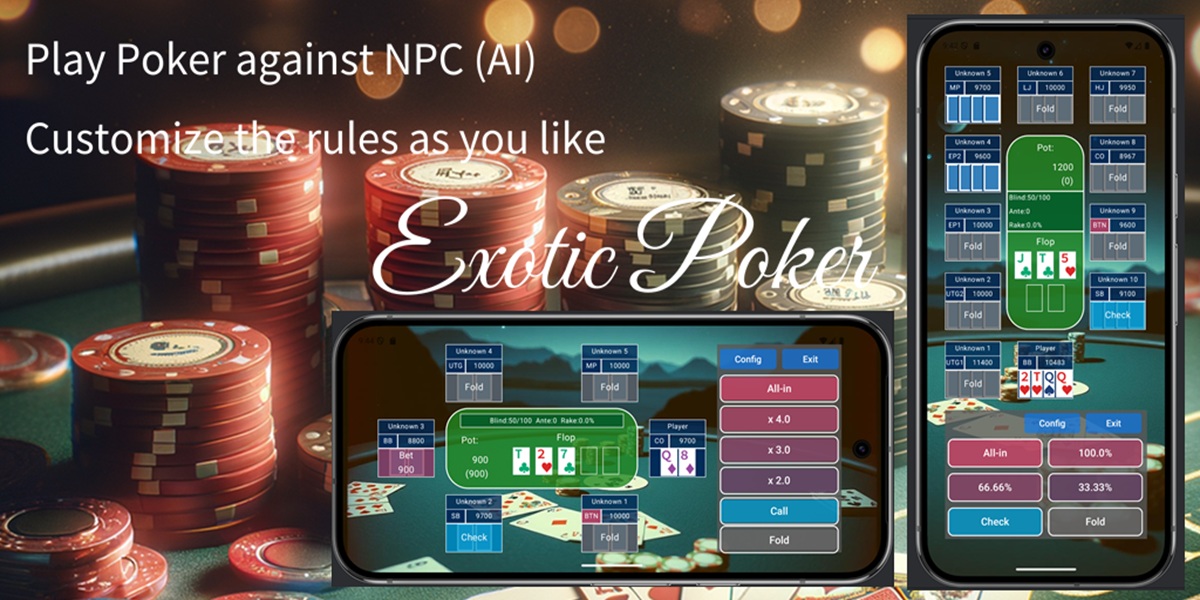
However, this approach also has its real issues. The lack of monetary pressure allows for casual play, making it hard to avoid behaviors like high VPIP or reckless betting sprees. Considering this, perhaps the operator’s credibility is ultimately the most crucial factor.
Games with Explicit Probability Manipulation
While probability manipulation is problematic, I somehow found myself thinking there might be a certain demand for games that explicitly allow players to manipulate probabilities. A new poker player would likely lose motivation if they kept losing in games filled only with strong players.
Therefore, adjusting probabilities based on a player’s experience (number of games played) or skill level might allow stronger and weaker players to compete on more equal footing. Games like shogi already use handicaps to level the playing field between strong and weak players; poker could potentially achieve this through (explicit) probability adjustments.
In the games I develop, I’m considering adding settings that explicitly allow probability adjustments for play (though I might not implement it…). When playing against AI, players might sometimes want to play in situations where they have an advantage, or conversely, in situations where they are at a disadvantage. It could be interesting to see how much the feel of play changes with such probability manipulation.
Another idea is to incorporate cheating into the game rules. Grant one player the right to randomly manipulate probabilities or play while viewing other players’ hands (cheating), leaving the decision to use this right up to the player. If exercised, it allows advantageous play, but other players gain the right to call them out (“You’re cheating, aren’t you?”). It might be fun to try a game with a setup where if a player uses probability manipulation or cheating and is called out on cheating, they’re eliminated (finishing last). (If they weren’t cheating, the accuser gets penalized.) Well, balancing the advantage gained from cheating and the penalty for a false accusation might be tricky though…


Comments